Security review completed – what we checked in the code
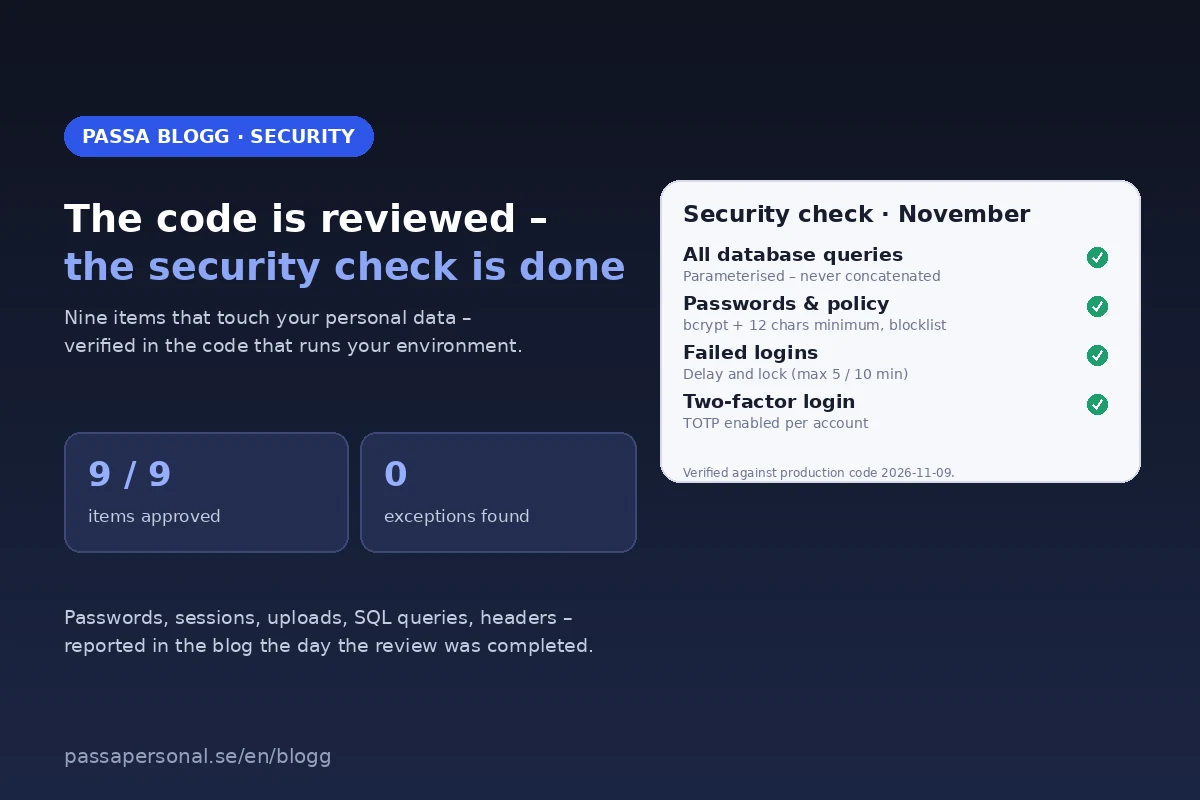
Before the year’s last release we stopped and read our own code properly – backend, admin and app. The goal was not a badge but knowing exactly what protects your data. Below are the items we could verify, line by line, in the code that actually runs your environment.
The checklist – nine items
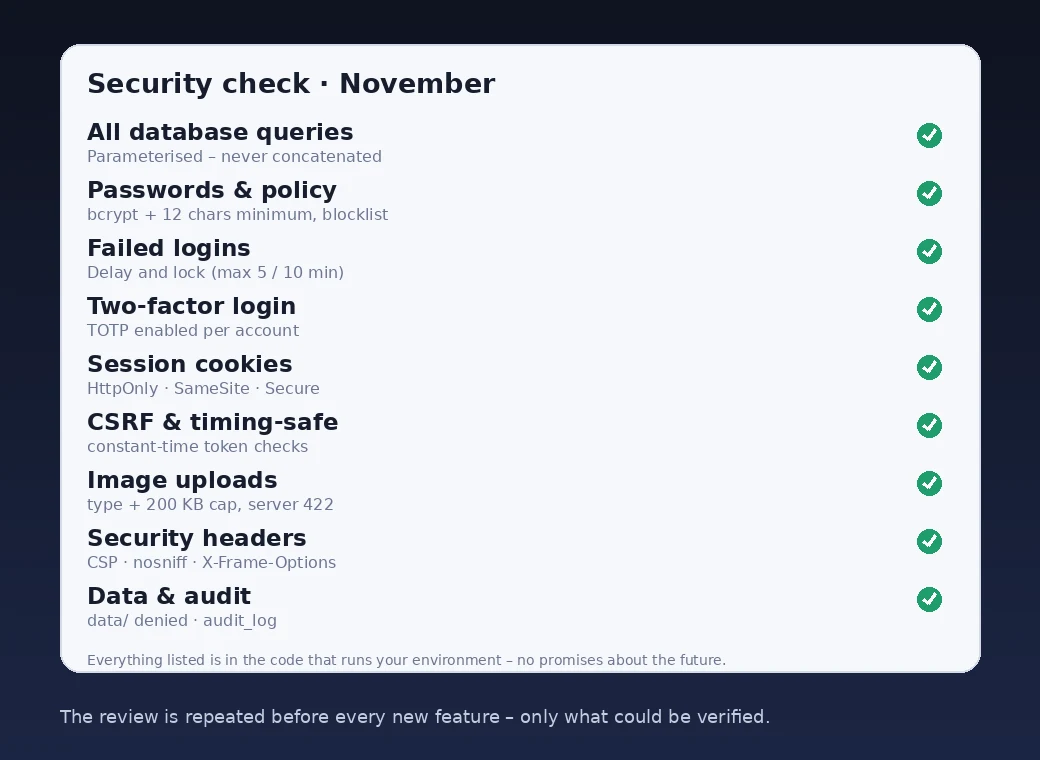
- Database queries: every request goes through one helper that always parameterises – no login or user data is ever concatenated into SQL. We found no exceptions.
- Passwords: stored as bcrypt hashes, never in clear text. Policy: at least 12 characters (16 alone passes) and common passwords are rejected outright.
- Failed logins: each attempt is slowed by a one-second delay and counted per account and IP – five attempts within ten minutes trigger a temporary lock.
- Two-factor login: a TOTP code can be enabled per account and is then required at login – a password alone is not enough.
- Session cookies: HttpOnly and SameSite=Lax, flagged Secure over HTTPS – browser JavaScript cannot reach the login state.
- CSRF and timing-safe checks: forms carry a session token compared with constant-time checks; password resets use short-lived tokens valid for 60 minutes.
- Uploads: receipt and meal photos are validated for both type and size (200 KB) on the server – wrong formats are rejected with 422, not just in the browser.
- Security headers: Content-Security-Policy, nosniff and X-Frame-Options are served from the server.
- Data and audit: the database folder is denied from the outside via .htaccess, and important events go to an audit log.
What we changed along the way
The review became a work list, not a stamp: we tightened image validation, added delay and lockout on repeated failed logins, introduced the password policy with a blocklist and removed dead endpoints. Everything is deployed and re-tested against production.
What it means for you – and what it is not
Your data in Passa is personal data: who works when, how much and where. The whole list is about protecting exactly that – logins with two-factor, hashed passwords, sealed forms and locked files. At the same time, to be honest: this is our own code review, not an independent audit or penetration test. A review is a point in time, not a promise – which is why we repeat it before every new feature and major release.